|
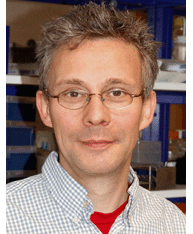
During mitosis and meiosis, the duplicated genetic information, the chromosomes, are separated by a precise machine, which is called the mitotic or meiotic spindle, to opposite spindle poles. After the subsequent cell division, each daughter cell has an identical chromosome set. Defects in this machine can lead to cancer or Down-Syndrom. Our work aims to understand how this machine works and is regulated. For this, we purify the protein components of the mitotic spindle and analyze their properties in the test tube. Using the new tools of genome editing (CRISPR-Cas9), we manipulate genes that code for mitotic spindle components in human tissue culture cells and monitor the defects by microscopy. In collaboration with chemists and structural biologists, we develop drugs that impair this machine specifically in dividing cancer cells.
Selected publications
Theile, L., Li, X., Dang, H.,, Mersch, D., Anders, S., and Schiebel, E. (2023). Centrosome linker diversity and its function in centrosome clustering and mitotic spindle formation. EMBO J., 2023 Jul 4 e109738. doi: 10.15252/embj.2021109738.
Atorino, E.S., S. Hata, C. Funaya, A. Neuner, and E. Schiebel. (2020). CEP44 ensures the formation of bona fide centriole wall, a requirement for the centriole-to-centrosome conversion. Nat. Comm., Feb 14;11(1):903. doi: 10.1038/s41467-020-14767-2.
Liu, P., E. Zupa, A. Neuner, A. Böhler, J. Loerke, D. Flemming, T. Ruppert, T. Rudack, C. Peter, C. Spahn, O.J. Gruss, S. Pfeffer*, and E. Schiebel*. (2019). Insights into the assembly and activation of the microtubule nucleator gamma-TuRC. Nature, doi: 10.1038/s41586-019-1896-6. [Epub ahead of print]. * Co-corresponding authors.
Hata, S.*, A. Pastor Peidro, M. Panic, P. Liu, E. Atorino, C. Funaya, U. Jäkle, G. Pereira, and E. Schiebel*. (2019). Therbalance between KIFC3 and EG5 tetrameric kinesins controls the onset of mitotic spindle assembly. Nat. Cell Biol., 21:1138-1151. * Co-corresponding authors.
Gunzelmann, J., D. Rüthnick, T.C. Lin, W. Zhang, A. Neuner, U. Jäkle, and E. Schiebel. (2018). The microtubule polymerase Stu2 promotes oligomerization of the gamma-TuSC for cytoplasmic microtubule nucleation. eLife, 2018 Sept 17;7. pii: e39932. doi: 10.7554/eLife.39932.
Vlijm, R., X. Li, M. Panic, D. Rüthnick, S. Hata, F. Herrmannsdörfer, T. Kuner, M. Heilemann, J. Engelhardt, S.W. Hell*, and E. Schiebel*. (2018). STED nanoscopy of the centrosome linker reveals a CEP68-organised, periodic rootletin network anchored to a C-Nap1 ring at centrioles. Proc. Nat. Acad. Sci. USA, 2018 Febr. 20. https://doi.org/10.1073/pnas.1716840115 [Epub ahead of print]. * Co-corresponding authors.
Zhang, W., A. Neuner, D. Rüthnick, T. Sachsenheimer, C. Lüchtenborg, B. Brügger, and E. Schiebel. (2018). Brr6 and Brl1 locate to nuclear pore complex assembly sites to promote their biogenesis. J. Cell Biol., 217:877-894.
Rüthnick, D., A. Neuner, F. Dietrich, D. Kirrmaier, U. Engel, M. Knop, and E. Schiebel. (2017). Characterization of spindle pole duplication reveals a regulatory role for NPCs. J. Cell Biol., 216:2425-2442 (see Abstract).
Lin, T., A. Neuner, D. Flemming, P. Liu, T. Chinen, U. Jaekle, R. Arkowitz, and E. Schiebel. (2016). MOZART1 and gamma-tubulin complex receptors are both required to turn gamma-TuSC into an active microtubule nucleation template. J. Cell Biol., 215:823-840 (see Abstract).
Cerikan, B., R. Shaheen, G.P. Colo, C. Gläßer, S. Hata, K.-P. Knobeloch, F.S. Alkuraya, R. Fässler, and E. Schiebel. (2016). Cell intrinsic adaptation arising from chronic ablation of a key Rho GTPase regulator. Dev. Cell , 39:28-43 (see Abstract). Interview with B. Cerikan
Chen, N.-P., B. Uddin, R. Voit, and E. Schiebel. (2016). Human phosphatase CDC14A is recruited to the cell leading edge to regulate cell migration and adhesion. Proc. Natl. Acad. Sci. USA, 113:990-995 (see Abstract).
Seybold, C., M. Elserafy, D. Rüthnick, M. Ozboyaci, A. Neuner, B. Flottmann, M. Heilemann, R.C. Wade, and E. Schiebel. (2015). Kar1 binding to Sfi1 C-terminal regions anchors the SPB bridge to the nuclear envelope. J. Cell Biol., 209:843-861. (see Abstract).
Lin, T., A. Neuner, Y. Schlosser, A. Scharf, L. Weber, and E. Schiebel. (2014). Cell-cycle dependent phosphorylation of yeast pericentrin regulates gamma-TuSC-mediated microtubule nucleation. eLife, 3:e02208 (see Abstract).
Gombos, L., A. Neuner, M. Berynskyy, L.L. Fava, R.C. Wade, C. Sachse, and E. Schiebel. (2013). GTP regulates the microtubule nucleation activity of gamma-tubulin. Nature Cell Biol., 15:1317-1327 (see Abstract).
Erlemann, S., A. Neuner, L. Gombos, R. Gibeaux, C. Antony, and E. Schiebel. (2012). An extended gamma-tubulin ring functions as a stable platform in microtubule nucleation. J. Cell Biol., 197:59-74 (see Abstract).
Roostalu, J., C. Hentrich, P. Bieling, I.A. Telley, E. Schiebel* and T. Surrey*. (2011). Directional switching of the kinesin Cin8 through motor coupling. Science, 332:94-99 (see Abstract). * Co-corresponding authors.
Mardin, B.R., C. Lange, J.E. Baxter, T. Hardy, S.R. Scholz, A.M. Fry and E. Schiebel. (2010). Components of the Hippo pathway cooperate with Nek2 kinase to regulate centrosome disjunction. Nature Cell Biol., 12:1166-1176 (see Abstract).
Khmelinskii, A., P.J. Keller, H. Lorenz, E. Schiebel* and M. Knop*. (2010). Segregation of yeast nuclear pores. Nature, 466(7305):E1 (see Abstract). * Co-corresponding authors.
Khmelinskii, A., J. Roostalu, H. Roque, C. Antony and E. Schiebel. (2009). Phosphorylation-dependent protein interactions at the spindle midzone mediate cell cycle regulation of spindle elongation. Dev. Cell, 17:244-256 (see Abstract).
Khmelinskii, A. , C. Lawrence, J. Roostalu and E. Schiebel. (2007). Cdc14-regulated midzone assembly controls anaphase B. J. Cell Biol., 177: 981-993 (see Abstract).
Pereira, G.* and E. Schiebel*. (2005). Kin4 kinase delays mitotic exit in response to spindle alignment defects. Mol. Cell, 19: 209-221 (see Abstract). * Co-corresponding authors.
Pereira, G.* and E. Schiebel*. (2003). Separase regulates INCENP-Aurora B anaphase spindle function through Cdc14. Science, 302: 2120-2124 (see Abstract). * Co-corresponding authors.
Tanaka, T.U., N. Rachidi, C. Janke, G. Pereira, M. Galova, E. Schiebel, M.J.R. Stark and K. Nasmyth. (2002). Evidence that the Ipl1-Sli15 (Aurora kinase-INCENP) complex promotes chromosome bi-orientation by altering kinetochore-spindle pole connections. Cell, 108: 317-329. (see Abstract).
Pereira, G., T.U. Tanaka, K. Nasmyth and E. Schiebel (2001). Modes of spindle pole body inheritance and segregation of the Bfa1p/Bub2p checkpoint protein complex. EMBO J., 20: 6359-6370 (see Abstract).
Pereira, G., T. Höfken, J. Grindlay, C. Manson and E. Schiebel. (2000). The Bub2p spindle checkpoint links nuclear migration with mitotic exit. Mol. Cell, 6: 1-10 (see Abstract).
underlined: PhD students or postdocs of the Schiebel lab
|
|
|