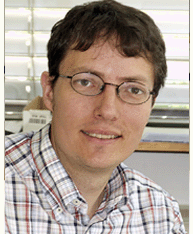
Georg Stoecklin ZMBH
Head of Biochemistry Division, Medical Faculty Mannheim of Heidelberg University & ZMBH Research Group Leader
Im Neuenheimer Feld 282
69120 Heidelberg, Germany
Tel: +49-6221-546797
Fax: +49-6221-545891
g.stoecklin@zmbh.uni-heidelberg.de
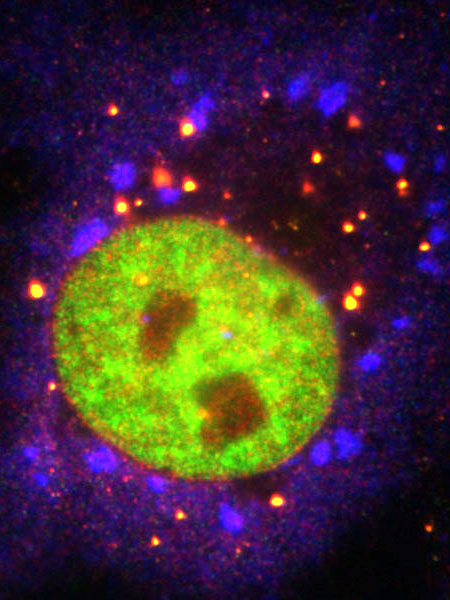
Welcome to the Stoecklin Lab! The activity of all eukaryotic genes is controlled in the nucleus at the level of transcription. In addition, gene expression is regulated at the posttranscriptional level in the cytoplasm through control of mRNA translation and degradation. Our lab examines molecular mechanisms by which mRNA decay and translation are controlled in mammalian cells. We investigate cis-acting RNA elements, trans-acting RNA-binding proteins and signaling pathways that specifically determine the fate of individual mRNAs. Our goal is to understand how the regulation of mRNA degradation and translation, both at the global level and at the level of individual mRNAs, contributes to innate immune activation, cellular differentiation and stress responses, and how the deregulation of posttranscriptional control participates in oncogenic transformation. Our Lab Georg Stoecklin is Professor for Biochemistry at the Medical Faculty Mannheim of Heidelberg University. The Stoecklin lab is part of of the CBTM (Center for Biomedicine and Medical Technology Mannheim). In addition, Prof. Stoecklin is associated with the ZMBH (Center for Molecular Biology of Heidelberg University) and member of the DKFZ-ZMBH Alliance. Sharma S, Poetz F, Bruer M, Ly-Hartig TBN, Schott J, Séraphin B, Stoecklin G (2016) Acetylation-Dependent Control of Global Poly(A) RNA Degradation by CBP/p300 and HDAC1/2. Mol Cell 63:927-38. Schott J, Reitter S, Philipp J, Haneke K, Schäfer H, Stoecklin G (2014) Translational Regulation of Specific mRNAs Controls Feedback Inhibition and Survival during Macrophage Activation. PLoS Genet. 10(6):e1004368. Leppek K, Schott J, Reitter S, Poetz F, Hammond MC, Stoecklin G (2013) Roquin promotes constitutive mRNA decay via a conserved class of stem-loop recognition motifs. Cell 153:869-81. Cytoplasmic mRNA is routed to "stress granules" (blue) after translational silencing, and delivered to "processig bodies" (yellow) for degradation.
RNA Translation & Turnover
Selected Publications
Hofmann S, Cherkasova V, Bankhead P, Bukau B, Stoecklin G (2012) Translation suppression promotes stress granule formation and cell survival in response to cold shock. Mol Biol Cell 23(19):3786-3800.
Spasic M, Friedel CC, Schott J, Kreth J, Leppek K, Hofmnn S, Ozgur S, Stoecklin G (2012) Genome-wide assessment of AU-rich elements by the AREScore algorithm. PLoS Genet. 8(1):e1002433.
Sandler H, Kreth J, Timmers HT, Stoecklin G (2011) Not1 mediates recruitment of the deadenylase Caf1 to mRNAs targetet for degradation by tristetraprolin. Nucleic Acids Res. 39(10):4373-86.
Ozgur S Chekulaeva M, Stoecklin G (2010) Human Pat1b connects deadenylation with decapping and controls the assembly of processing bodies. Mol Cell Biol 30:4308-23.
Stoecklin G, Stubbs T, Kedersha N, Wax S, Rigby WFC, Blackwell TK, Anderson P. (2004) MK2-induced tristetraprolin:14-3-3 complexes prevent stress granule association and ARE-mRNA decay. EMBO J 23:1313-24.