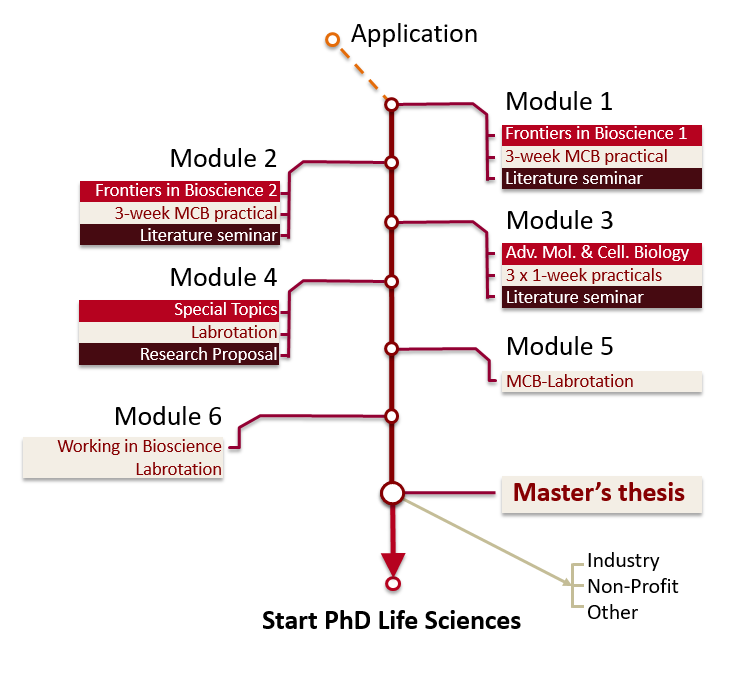

The MSc course lasts for 4 semesters (2 years), starting at the beginning of October each year.
Semester 1
This semester consists of two modules (Frontiers of Biosciences 1 & 2) which provide a solid background in advanced molecular biosciences, particularly concentrating on aspects which are represented by Heidelberg researchers. Each module lasts 9 weeks, of which 6-7 weeks are spent in course work. 2-3 weeks are allowed for exam preparation. The formal course work for each module consists of:
Lectures which provide theoretical information, with accompanying Tutorials. The lectures are attended by all students of the MSc course. At the end of the module students are examined on the content of the lecture course.
Practicals (either 3 week course practicals or 6 week lab rotations) allow students to obtain diverse laboratory skills, and to observe in practice selected topics from the lectures. Each practical is accompanied by a Seminar in which relevant articles from the primary literature are critically discussed. The seminars also allow students to practice language and presentation skills.
Topics are as follows:
Course title: Crash course in molecular methods
Lecturers: C. Clayton, B. Dobberstein
Course Content: This course is intended for students from all Majors who have unusually little experience in practical methods of molecular biology. These students are usually from universities that do not posess well equipped practical teaching facilities. The course is also appropriate for students coming from non-biological backgrounds, e.g. physics, chemistry. The course is to be taken instead of a more specialized course in the student´s Major after agreement with the Major coordinator.
Duration: 3 weeks, full day + seminar
Course title: Cell free systems and genetic strategies to analyse protein targeting and sorting in cells
Lecturers: B. Dobberstein, M. Seedorf
Course Content: The aim of the practical is to investigate protein transport in the secretory pathway using different experimental systems. You will learn how to develop and set-up a cell-free (in vitro) translation/translocation system. With such system reconstituted from from isolated components, you will than study the translocation process of different types of secreted- and membrane proteins. This work will include the preparation of in vitro transcripts, the preparation and characterisation of microsomal membranes, assays for protein translocation and studies addressing the topology of transmembrane proteins.
In the second part, the steps following the translocation or insertion of proteins into the ER, namely transport of cargo out of the ER, transfer through the Golgi apparatus, and sorting to a final destination will be investigated by a genetic approach in the model organism Saccharomyces cerevisiae. We recapitulate some groundbreaking experiments, which led to the discovery of many components of the secretory pathway. You will perform a genetic screen, isolate conditional mutants and analyze protein secretion in these mutants.
Duration: 3 weeks, full day + seminar
Course title: Biochemistry of cell organelles
Lecturers: E. Hurt, F. Wieland, M. Brunner
Course Content: The objective of the course is the acquisition of knowledge of modern biochemical methods, which the participants must then apply to the solution of problems in the field of cell organelles. Throughout the semester, students give oral presentations on subjects discussed in the course bibliography, with the double purpose of perfecting their oral skills and acquiring the necessary background knowledge.
The relevant themes are divided into three groups:
1 Reconstruction of the intercellular vesicular transport
1.1 Subcellular fractioning of liver homogenates for the enrichment/enhancement of Golgi membranes
1.2 Recruiting of cytosolian COPI-cyst components at/to Golgi membranes
2 Nuclear transport and ribosome biogenesis
2.1 Protein transport through nuclear pores
2.2 mRNA biogenesis
2.3 Ribosome biogenesis
3 Mitochondria: structure and function
3.1 Protein import in mitochondria
3.2 TIM/TOM complex
Applied techniques: E. coli and S. cerevisiae lysis, affinity purification with TAP and GST tags, SDS-PAGE, in vitro binding studies, differential centrifugation, immunoprecipitation, western blotting, protein determination, in vitro membrane binding experiments, cultivation of N. crassa, isolation of mitochondria from N. crassa and S. cerevisiae, in vitro transcription and translation of a chimeric protein, protein import in isolated mitochondria.
Duration: 3 weeks, full day + seminar
Course title: Biochemistry of the cell: molecular methods to study protein folding and protein interactions
Lecturers: B. Bukau, A. Mogk, M. Mayer
Course Content: The objective of this course is to provide you with an introduction to the complex problematic of protein folding and degradation in the cell. You will work with different key chaperones and a protease, which mediate protein folding, disaggregation and degradation. During this course you will learn different methods to probe protein folding and degradation in vitro and in vivo. In addition you will gain hands on experience in basic methods of protein purification and characterization. You will learn fundamental biochemical and biophysical methods like ATPase assays, basic CD and fluorescence spectrometry, one and two dimensional gel electrophoreses, western blotting and MALDI mass spectrometry, which are of great use in characterizing proteins and enzymatic activity in all areas of biochemical and biophysical research.
Duration: 3 weeks, full day + seminar
Course title: Antibodies - essential tools in molecular cell biology. Recapitulate the discovery of sumoylation.
Lecturers: F. Melchior and lab members
Course Content: Antibodies are extremely valuable tools in all aspects of molecular cell biology. They serve to investigate protein expression and localization in cells, allow identification of binding partners and of posttranslational modifications, and can be used as inhibitors in the analysis of intracellular processes. The aim of the practical is to develop an appreciation for the power of high quality antibodies in molecular cell biology. After purifying recombinant untagged RanGAP1 from bacteria (involving refolding, anion exchange chromatography and gel filtration), you will affinity purify polyclonal anti RanGAP1 antibodies from serum and use them in immunoblotting, immunoprecipitation and immunofluorescence studies (requires cultivation of HeLa cells and preparation of diverse HeLa lysates). With these experiments you will recapitulate some key experiments in the discovery that RanGAP1 is posttranslationally modified with SUMO1. Upon site directed mutagenesis of an HA epitope tagged RanGAP1, you will compare wt and sumoylation deficient RanGAP1 localisation by immunofluorescence analysis with monoclonal anti HA antibodies in transfected HeLa cells. Seminars given by the instructors will cover antibody production, purification and applications. Literature seminars given by the students will be based on original articles that demonstrate application of antibodies in nucleocytoplasmic transport and mitosis (Ran GTPase cycle) and in the field of posttranslational modifications (sumoylation, ubiquitylation and phosphorylation).
Duration: 3 weeks, full day + seminar
Course title: Gene expression
Lecturers: C. Clayton, R. Voit, G. Stoecklin
Duration: 3 weeks, full day + seminar
Course Content: In this practical we study various aspects of gene expression. The first week is devoted to epigenetics in mammalian cells, while the second two weeks are spent characterising RNA in both animal cells and trypanosomes. Students will learn chromatin immunoprecipitation, Northern blotting, and in situ hybridisation, study mRNA polyadenylation and degradation, and use RNA interference to study export of mRNAs from the nucleus. Success in the course is judged by written reports and answers to questions, as well as adequate lab book maintenance and performance in the lab.
In the accompanying seminar students will analyse recent publications covering a broad variety of functions of RNA. The grade is based on an oral ad projected presentation and on participation in discussions.
Course title: Mechanisms and regulation of eukaryotic cell division.
Lecturer: E. Schiebel
Duration: 3 weeks, full day + seminar
Practical and seminar groups are small (usually no more than 12 students) giving an excellent opportunity for interactions between the students and the teaching staff. Student participation in the practicals and seminars contributes to the final grade.
Semester 2
Like semester 1 this semester is organised into two modules (Focus Bioscience 1 & 2), however, all of the teaching is specific to the Major which has been chosen by the student.
Module Focus Bioscience 1
The lecture course will describe advanced methods and their application, illustrated by recent discoveries. Topics will include:
Genomics and transcriptomics, Mass spectrometry and proteomics, Crystallography, Cryo-EM and reconstruction, NMR, CD
Protein-protein interactions, Live cell microscopy and FRET, Quantitative biochemistry (metabolomics, metabolic modelling)
Immunological methods in research and diagnosis, Enzyme kinetics, Yeast as a model system, Biocomputing
The practical classes with seminars are divided into one-week blocks. Each student chooses three blocks. Topics are as follows:
Course title: Enzyme kinetics and protein folding
Lecturers: J. Reinstein, I. Grömping
Course Content: The goals of this practical course include characterization of ligand binding and catalysis mediated by enzymes as well as protein folding mechanisms. These processes will be quantitated by following changes in absorption, fluorescence intensity and anisotropy as well as circular dichroism. Besides these techniques (applied in equilibrium and kinetic modes) equilibrium techniques that provide binding enthalpies (calorimetry) will also be applied. Finally, different models and software packages will be used to analyze and evaluate the data to obtain equilibrium binding and rate constants that finally lead to the deduction of enzymatic and protein folding mechanisms.
Duration: 1 week, full day
Course title: Structural Biology I+II
Lecturers: I. Sinning, I. Schlichting
Course Content: Structural information on substrate specificity, and transition state geometry are important ingredients for deriving enzymatic reaction mechanisms and understanding protein function. The course will introduce methods used to characterize protein-ligand interactions in the crystalline state. Experimental approaches include crystallographic ones like soaking, microspectroscopy and mass spectroscopy of crystals followed by diffraction data collection, structure determination and interpretation.
Duration: 2 weeks, full day
Course title: Mass spectrometry
Lecturers: M. Mayer, T. Ruppert
Course Content: Aim of the course: Hands-on experience with different mass spectrometers, state of the art techniques in protein analytics and proteomics. MALDI-TOF, LC-ESI-QTOF and nanoLC-ESI-Orbitrap mass spectrometry is used to identify proteins out of 1D and 2D-SDS-gels, to analyze posttranslational modifications like phosphorylation, and to analyze protein conformation using amide hydrogen mass spectrometry.
Duration: 1 week, full day
Course title: RNA/Ribozymes
Lecturers: A. Meinhart, K. Wild, I. Sinning; max. 6 Stud.
Course Content: RNA techniques: Production and characterization of RNA-hammerhead ribozymes, analysis of RNA/protein complex formation by biochemical and biophysical techniques.
Duration: 1 week, full day
Course title: Live Microscopy of living objects
Lecturers: V. Sourjik, S. Erhardt
Course Content: Proteins tagged with fluorescent proteins like GFP and its variants are widely used to study the behaviour of cells within their physiological context. The course will introduce to applications of various types of microscopy. In the course you will record time-lapse movies of Drosophila embryo by confocal, epifluorescent and DIC microscopy. Moreover, you will perform fluorescence recovery after photobleaching (FRAP) experiments on bacteria and yeast cells using laser-scanning confocal microscope, and fluorescence resonance energy transfer (FRET) experiments on bacteria using wide-field microscope.
Duration: 1 week, full day
Course title: Insights into research and development of drugs
Lecturers: A. Vogt, H. Kropshofer
Course Content:
Overview R&D of classical small molecules versus therapeutic biologics.
Therapeutic antibodies: from biology and immunology to the discovery of a new drug.
Requirements nowadays prior to entry into humans.
Pre-clinical and clinical immunosafety: from EPO to TeGenero.
Human cell-based assays to assess potency and toxicity of a clinical candidate.
Novel drugs against Autoimmunity, Cancer and Alzheimer’s Disease in clinical trials.
Duration: 1 week, full day
Course title: RNA methods
Lecturers: C. Clayton, G. Stoecklin
Course Content: Preparation of total RNA; Separation of cytoplasmic and nuclear RNA; separating RNAs by denaturing agarose and polyacrylamide gel electrophoresis; Northern blot; Sequence-specific RNA digestion using an oligonucleotide and RNase H; Determining the half-life of an mRNA; Primer extension and reverse-trasncriptase PCR; RNase protection; In situ hybridisation.
We will analyse 4-5 chosen RNAs in trypanosomes and mammalian cells. Several of the methods involve work with radioactivity.
Duration: 1 week, full day
Course title: The use of Xenopus laevis egg extracts for the ex vivo analysis of cell division processes
Lecturer: O. Gruss
Course Content: Lysates from Xenopus eggs are the best established cell free system for the analysis of cell division and cell cycle processes, like e.g. spindle formation, chromosome segregation and nuclear envelope disassembly and reformation. The aim of this course is to introduce applications and advantages of this complex cell free system in comparison to the analysis of cell division processes in living cells. The practical will therefore focus on the function of selected microtubule associated proteins for spindle assembly using both systems.
Duration: 1 week, full day
Course title: Protein simulation and modeling
Lecturer: S. Fischer
Course Content: Modern techniques in molecular modeling, simulation and graphics allow us to watch a single protein at atomic resolution, in real time and under physiological conditions - something that is not possible with experimental methods. This allows to truly understand the functional mechanism of a protein.
The course explains these techniques, starting from the basics. Their application is illustrated on examples such as the molecular motor in
muscle, the selectivity of trans-membrane channels and pumps, and the catalytic
activity of enzymes. In the practical part, students start by downloading a protein from the Protein Data Bank of structures. The structure of this protein is then examined on workstations equipped with three-dimensional graphics, and computer simulations are performed. This includes watching the flexible deformation modes of the protein, observing its atomic motions with
Molecular Dynamics, simulating an enzymatic reaction, and computing ligand binding properties. Given the interdisciplinary nature of the subject, the course is structured to address students with different scientific backgrounds.
Duration: 1 week, full day
Module Focus Bioscience 2
In this module students are introduced to the research topics which are available within the MCB Major. Lecturers will first give a detailed background introducing the topic, then describe the open questions which are currently under investigation in Heidelberg and elsewhere.
In addition, each student does 6 weeks of practical work in the laboratory of one of the teachers in the MCB program and takes part in, and contributes to, the laboratory research and literature seminars of the research group.
Semester 3
Each student undertakes two 6-9 week projects (Modules Biolab and Working in Bioscience) in different laboratories of the Major and takes part in, and contributes to, the laboratory research and literature seminars of the research group. Alternatively one practical can be done in the context of another Major, or within a foreign exchange programme.
Semester 4
The Module Masters thesis work lasts up to six months and is done in the laboratory of one of the teachers in the MCB programme. You undertake a laboratory research project relevant to the Major, write a thesis, and defend it in an oral presentation.
Organization of Master programme (click to view larger image in new window)

Structure of 1st semester (click to view larger image in new window)

Structure of 2nd semester (click to view larger image in new window)
Special exchange programme: Life Science for Health (LSH)
Selected Heidelberg students will be able to spend part of Semester 3 in either the Karolinska Institute, Stockholm or the University Medical Centre Leiden, The Neth
erlands. The LSH program allows for the exchange of students studying in Master programmes in the three institutions.

Structure of 3rd semester (click to view larger image in new window)

Structure of 4th semester (click to view larger image in new window)